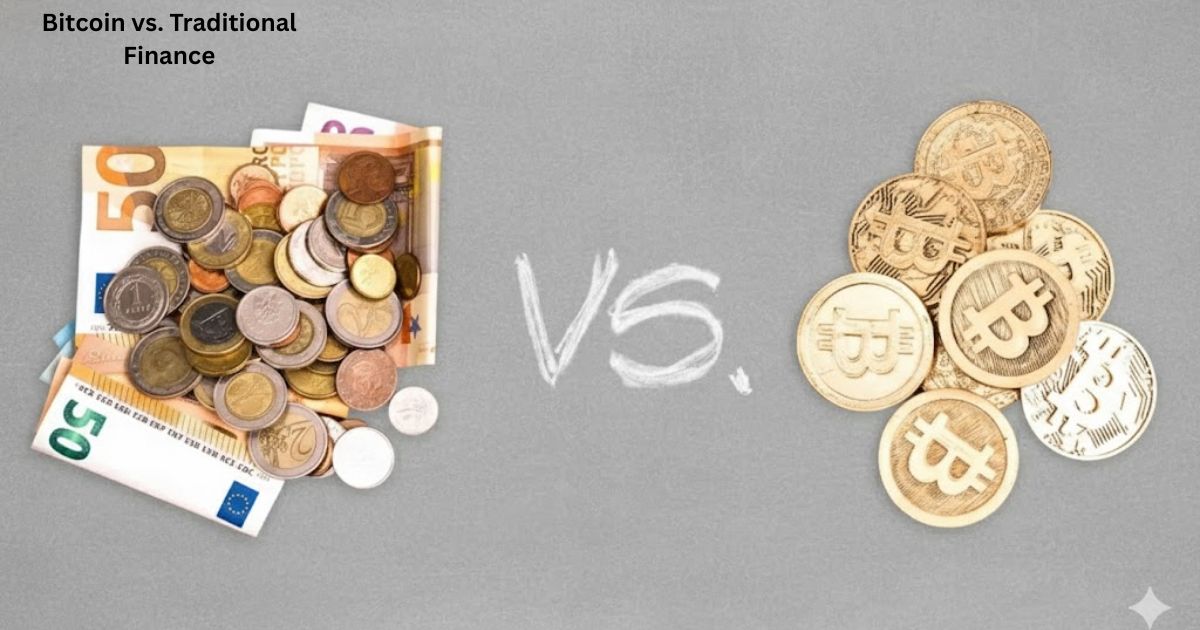
Bitcoin vs. Traditional Finance-There are moments in history when old ways and new ideas collide so dramatically that the world is forced to sit up and pay attention. Right now, we are living through one such moment. Whether you’re scrolling through social media, watching market updates, talking to young investors or overhearing café debates, one question keeps surfacing: Bitcoin vs. Traditional Finance — who actually wins the future?
This isn’t just a clash of technology. It’s a clash of belief systems. On one side sits centuries of established banking, regulatory frameworks, institutions, paper money and the comfort of familiarity. On the other stands a decentralized digital currency built on code, math, open networks and the dream of financial freedom.
People feel the tension because it’s not just a financial debate; it’s an emotional one. It’s about trust. Safety. Speed. Freedom. Control. Possibility. And the future of how we handle money — the most influential tool in society.
So today, let’s break down this massive face-off in a way that feels real, relatable and grounded. Let’s explore how Bitcoin vs. Traditional Finance is shaping everything from investment habits to global policy and whether the future will belong to digital revolutionaries or centuries-old institutions.
The Rise of Bitcoin: From Fringe Idea to Cultural Phenomenon
Fifteen years ago, Bitcoin sounded like something cooked up in a sci-fi novel. A mysterious creator named Satoshi Nakamoto, a peer-to-peer currency, no banks, no borders, no central authority — it felt too futuristic to be taken seriously. But as more people tried it, mined it, traded it and understood its potential, Bitcoin transformed from an Internet curiosity into a global movement.
What pushed Bitcoin forward were ideas bigger than profit. It was the belief that money should not be controlled by a single government, manipulated by inflation, or restricted by traditional banks. For millions, Bitcoin represented financial empowerment. For others, it was an investment opportunity that could make them wealthy. For some, it was both.
| Key Aspect | How It Shapes the Bitcoin vs. Traditional Finance Debate |
|---|---|
| Trust, Technology, Regulation, Accessibility | These factors decide which system dominates the financial future |
Today, the conversation about Bitcoin vs. Traditional Finance isn’t just happening among techies or traders. It’s happening in corporate boardrooms, political circles, regulatory offices, family dinners and universities worldwide. Bitcoin has moved from the fringes to the front page. And traditional finance can no longer ignore it.
Traditional Finance: The Old Guard That Built the World
Traditional finance has been the backbone of global society for centuries. Banks, stock markets, insurance companies, governments and regulators form a network that has funded wars, developed nations, built businesses and managed the world’s money flows. There’s comfort in its structure. There’s trust in its stability.
People know what a bank is. People rely on government-backed currency. People understand interest rates, branches, ATMs and financial paperwork because these systems have existed for generations. This familiarity gives traditional finance its greatest strength — people instinctively believe in it.
But this long history also comes with baggage. Bureaucracy slows it down. Centralization gives institutions immense control. And repeated crises — from recessions to bank failures — have shaken public trust. This is where the Bitcoin vs. Traditional Finance debate gains fire. Traditional systems are powerful, but they’re not perfect. And in a world that’s moving faster than ever, people are questioning whether the old way still fits the new world.
The Core Clash: Decentralization vs. Centralization
The real fight at the heart of Bitcoin vs. Traditional Finance is not about price predictions or flashy headlines. It’s about who controls the money.
Bitcoin operates on decentralization. No single institution governs it. Transactions are verified by a network, not a bank manager. It’s transparent, open-source and borderless. This gives people control over their own money in a way traditional systems never allowed.
Traditional finance, meanwhile, is centralized. Governments print and control currency. Banks manage deposits, loans, transfers and savings. Every financial action requires a middleman. For many, this feels safe and secure. For others, it feels restrictive and outdated.
This philosophical divide is what keeps the debate alive. Do people want money controlled by institutions or by themselves? Do they want stability or freedom? Familiarity or innovation? That’s the emotional core of Bitcoin vs. Traditional Finance.
The Trust Factor: Who Do People Believe More?
Trust is the most valuable currency on Earth. And both sides of Bitcoin vs. Traditional Finance rely heavily on it.
People trust traditional finance because it is regulated, insured, supervised and backed by governments. If something goes wrong with a bank account, there are laws and institutions that offer protection. The system feels safe because it has guardrails.
Bitcoin, on the other hand, earns trust differently. It earns trust through mathematics, algorithms and transparency. The blockchain records every transaction openly. There’s no hiding, no manipulation, no printing money out of thin air. Bitcoin users trust the system because the system is designed not to lie.
The question then becomes: Do people trust humans or do people trust code? Do they prefer rules set by institutions or rules set by consensus? The answer differs by generation, by experience, by perspective — and that’s why Bitcoin vs. Traditional Finance is so fascinating.
The Speed Factor: The World Moves Fast, Money Should Too
In a world where messages travel instantly, videos stream instantly and shopping happens instantly, people expect money to move instantly too. This is where Bitcoin has captured imaginations.
Bitcoin transactions don’t wait for bank timings, holidays or clearance cycles. They happen anytime, across borders, without asking anyone for permission. This level of speed and freedom is what pushes young users toward Bitcoin.
Traditional finance, despite its advancements, still feels slow in comparison. Large transfers take days. International transactions require approvals. Paperwork clogs processes. Timings restrict movement. People wonder why, in a digital age, money is still crawling.
This growing impatience is fueling the Bitcoin vs. Traditional Finance debate. The world wants faster finance — and Bitcoin delivers that promise boldly.
The Accessibility Divide: Who Gets to Participate?
One of the biggest questions in Bitcoin vs. Traditional Finance is about access.
Traditional finance often excludes people. You need documents, credit history, stable income, specific qualifications, and sometimes even a certain social standing to access financial services. Millions of people across the globe remain “unbanked” because they don’t meet these criteria.
Bitcoin changes that. Anyone with a smartphone and Internet connection can participate. No background checks. No discrimination. No bias. It democratises access to financial tools previously reserved for select groups.
That’s why many view Bitcoin not as a currency, but as a movement — one that gives people power they never had before.
The Volatility Problem: Bitcoin’s Greatest Strength and Weakness
Bitcoin’s price swings are legendary. They create millionaires. They create panic. They dominate headlines. And they spark endless arguments.
Traditional finance is relatively stable because governments regulate economies, adjust interest rates and intervene during crises. Bitcoin, however, runs on supply and demand. There is no authority to stabilize its value, which means it can soar spectacularly and crash dramatically.
Supporters say this volatility shows Bitcoin’s potential. Critics say it proves Bitcoin is unreliable. The truth lies somewhere in the middle. Volatility makes Bitcoin exciting — but also risky. And this becomes a major point in the Bitcoin vs. Traditional Finance comparison.
The Regulation Factor: Governments Enter the Ring
No discussion of Bitcoin vs. Traditional Finance is complete without addressing regulation.
Governments around the world are watching Bitcoin closely. Some embrace it. Some restrict it. Some tax it heavily. Others ignore it. The uncertainty creates tension but also reveals how impactful Bitcoin has become.
Traditional finance, on the other hand, operates under strict rules. Every transaction is monitored. Fraud laws exist. Consumer protection is strong. This regulation makes the system controlled but safe.
The future will likely blend both worlds: Bitcoin gaining regulation, and traditional finance embracing innovation.
Generational Divide: Young vs. Old, Risk vs. Stability
Young investors often see Bitcoin as the future — borderless, digital, fast, independent. They don’t fear technology. They grew up with it.
Older generations lean toward traditional finance — stable, regulated, familiar and dependable. Their trust is shaped by decades of banking experience.
This generational divide adds heat to the Bitcoin vs. Traditional Finance discussion, because both groups are convinced they’re right. And in a way, both are.
The Future: Is a Hybrid Financial World Inevitable?
The world rarely picks one extreme over another. The future of Bitcoin vs. Traditional Finance may not be about who wins, but how they merge.
Traditional institutions are already adopting blockchain. Banks are exploring digital money. Bitcoin is being integrated into payment systems. Governments are testing central bank digital currencies.
It is becoming clear that the future may be a hybrid system — one where Bitcoin pushes innovation and traditional finance provides structure.
Final Verdict: Bitcoin vs. Traditional Finance — Who Wins?
If you’re expecting a one-word answer, the truth is more nuanced. In the long run, the winner may not be one or the other. The winner might be the consumer. The winner might be innovation. The winner might be a world where freedom and structure coexist.
Bitcoin will influence the future. Traditional finance will adapt. And together, they will reshape how humanity interacts with money.
In the race of Bitcoin vs. Traditional Finance, the real victory belongs to a world that thinks boldly, adapts quickly and builds systems that empower everyone.