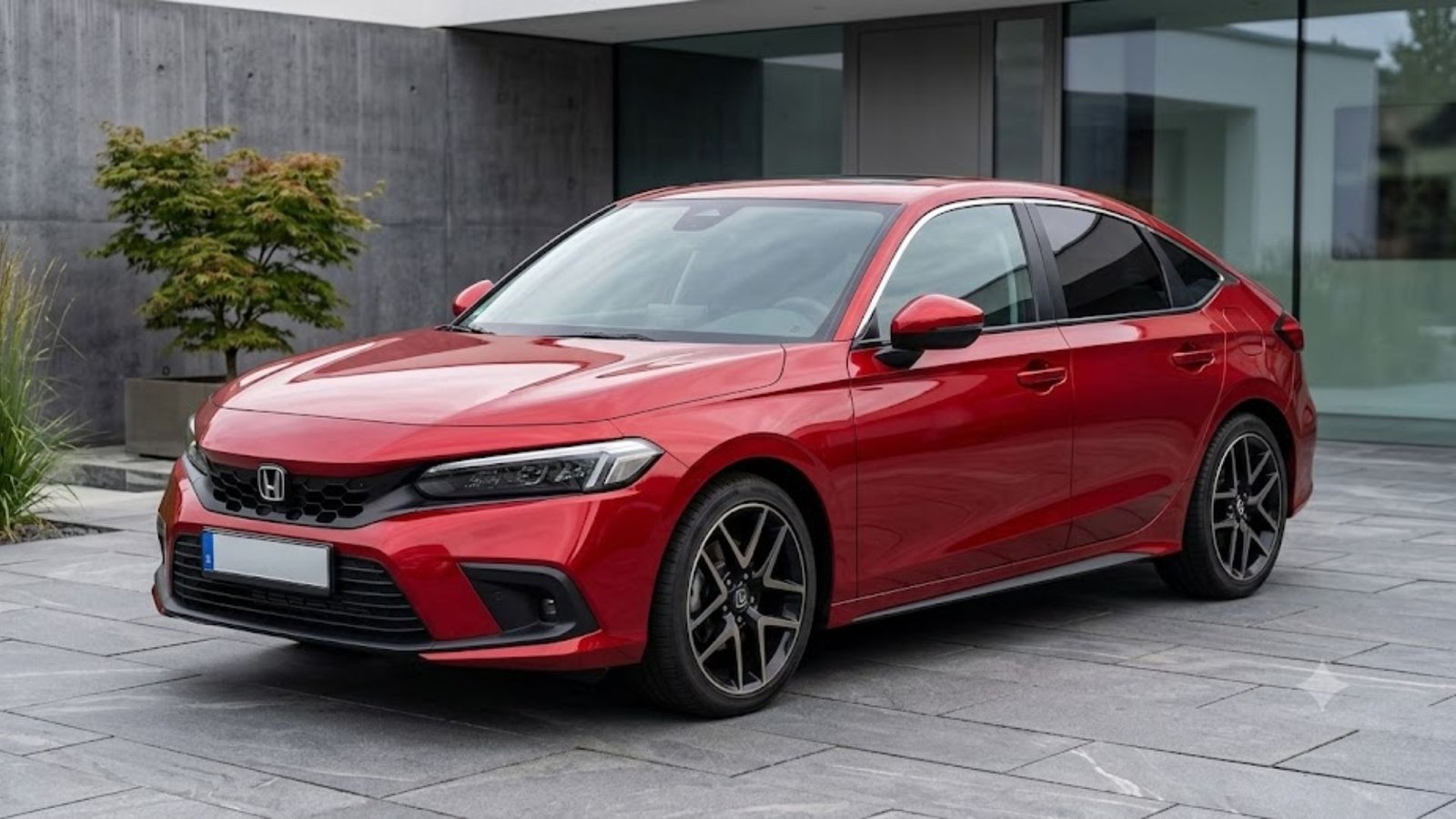
Honda Civic-If you grew up watching sedans rule Indian roads, chances are the Honda Civic holds a special place in your memory. It wasn’t just another car — for a certain generation of enthusiasts, it was the car. Sharp handling, a cabin that felt years ahead of its time, and that distinct exhaust note made the Civic a genuine head-turner back in the day. So when whispers started doing the rounds that Honda is once again considering the Civic for India, it’s no surprise that car forums, YouTube comment sections and WhatsApp groups lit up almost overnight.
Let’s be clear from the start — Honda hasn’t made any official announcement yet. But there’s enough industry chatter, dealer-level buzz and product-strategy hints to suggest that the Civic could be back on Indian soil, most likely as a completely built-up (CBU) import aimed at enthusiasts rather than the mass market. In this article, we’ll break down everything reportedly known so far — expected price, likely launch window, engine options, features, safety kit, rivals, and honestly, whether it’s even worth waiting for.
Why Is Everyone Talking About the Honda Civic Again?
Honda Civi Cars India has been playing it relatively safe over the last few years, leaning heavily on the City and the Amaze to keep volumes ticking. But that’s slowly changing. With the ZR-V hybrid SUV already introduced as an import and more global products reportedly being evaluated for India, Honda seems to be testing the waters with a “bring in the icons” strategy rather than chasing outright volume.
The Civic, along with the Accord and CR-V, is said to be part of this evaluation. None of these three have received a formal launch confirmation, but industry watchers believe Honda could bring in a limited number of units through select dealerships, similar to how other automakers have used the CBU route for halo models. It’s a low-risk way to test demand without investing in local assembly.
So while nothing is locked in on paper, the direction Honda seems to be heading in makes a Civic comeback a realistic possibility rather than just wishful thinking from old-school fans.
Honda Civic Key Details at a Glance
Honda Civi-Here’s a quick snapshot of what’s expected, based on current reports and industry speculation. Treat these as indicative figures until Honda makes anything official.
| Detail | Expected Information |
|---|---|
| Body Type | Sedan (possible coupe-style variant discussions) |
| Import Route | CBU (Completely Built Unit), likely limited units |
| Expected Price Range | Roughly ₹30 lakh to ₹42 lakh (ex-showroom) |
| Engine Options | 2.0L petrol and hybrid powertrain (reportedly) |
| Power Output | Around 150–200 hp depending on variant |
| Mileage (Expected) | 16–18 kmpl petrol, 20–23 kmpl hybrid (real-world estimates) |
| Transmission | CVT automatic likely across variants |
| Safety Suite | Honda Sensing (ADAS features expected) |
| Key Rivals | Hyundai Elantra, Skoda Octavia/Slavia, Volkswagen Virtus (higher trims) |
| Launch Timeline | Not officially confirmed; reportedly within this financial year |
Keep in mind, these numbers are floating around in the industry and enthusiast circles — Honda India has not put out an official statement confirming pricing, specifications or a launch date.
A Quick Look Back: Why the Civic Mattered in India
Honda Civi-Honda first brought the Civic to India back in 2006, and it genuinely shook up the segment. At a time when most sedans were designed to be practical and forgettable, the Civic had attitude. It looked different, it drove differently, and it made people who didn’t care much about cars suddenly care.
The later generations kept that spirit alive to varying degrees, but rising prices, a shrinking sedan market and increasing SUV obsession among Indian buyers eventually led Honda to discontinue the Civic in India in 2022. It wasn’t that the car was bad — the market had simply moved on. Which is exactly why this potential comeback feels a bit different this time. Honda isn’t necessarily trying to win the sales charts with the Civic; it’s trying to reconnect with buyers who still value driving pleasure over back seat space.
Expected Price: Is the Honda Civic Worth the Money?
Honda Civi-This is where things get interesting, and honestly, a little tricky. Reports suggest the base variant could start somewhere around ₹30 lakh ex-showroom, with the hybrid and top-spec trims potentially crossing ₹40 lakh. If the Civic does come in as a CBU import, expect on-road prices in cities like Mumbai and Bengaluru to climb noticeably higher once you add registration and duties on top.
Now compare that to the outgoing 11th-generation Civic, which used to retail in the ₹18–22 lakh bracket before it was discontinued. That’s a massive jump, and it puts the new Civic well above mainstream sedan territory and closer to premium executive sedans.
Here’s the honest opinion part: at ₹30 lakh-plus, the Civic will no longer be competing with cars like the City or Verna. It’ll be rubbing shoulders with the Hyundai Elantra and even brushing against entry-level Skoda Octavia pricing. For that kind of money, buyers will expect a lot more than just a badge and nostalgia. The car will genuinely need to justify its price through refinement, features and that classic Honda driving feel.
Engine, Performance and Real-World Usability
Honda Civi-Reportedly, Honda could offer the Civic with a 2.0-litre naturally aspirated petrol engine producing close to 150–158 hp, paired largely with a CVT automatic gearbox. There’s also talk of a hybrid powertrain option, which could push power closer to the 200 hp mark while significantly improving city mileage — something that matters a lot in Indian traffic conditions.
If you’ve ever driven a Honda with a CVT, you’ll know the drill — smooth, refined, and honestly quite relaxing in daily traffic, though enthusiasts sometimes miss the engagement of a proper manual or a dual-clutch setup. For someone doing a mix of city commuting and highway drives, this kind of setup usually works well in real life, even if it doesn’t sound as exciting on paper as a turbo-petrol.
Mileage figures, as expected, are still unofficial, but early estimates suggest something in the range of 16–18 kmpl for the petrol version and 20–23 kmpl for the hybrid in real-world city conditions. Highway mileage would likely be a notch higher. These aren’t segment-leading numbers, but they’re reasonably competitive for a car in this performance bracket.
Features and Cabin Experience
Honda has traditionally been strong when it comes to cabin ergonomics, and the Civic is expected to continue that trend. Based on the global-spec Civic sold in markets like the US and Southeast Asia, Indian buyers could expect:
Comfort and Convenience
- Leather or leather-like upholstery on higher trims
- Power-adjustable driver’s seat
- Heated front seats (useful more in northern winters than most of India, but a nice touch)
- Dual-zone climate control
- Wireless charging and connected app support
Infotainment and Connectivity
- A sizeable touchscreen infotainment system
- Wireless Android Auto and Apple CarPlay
- Premium audio system on top trims — Bose branding has been mentioned in several reports, though this is not officially confirmed
Software and Digital Experience
Honda Civi-Honda’s recent global models have leaned into a cleaner, less cluttered infotainment layout, and if the Civic follows that same design language, it should feel noticeably more modern than the outgoing model. That said, Indian-spec software localisation, voice assistant support in regional languages and app ecosystem integration will only be clear once Honda India confirms the exact spec sheet.
Safety: What to Expect from Honda Sensing
One of the more encouraging bits of information doing the rounds is that the Civic could come equipped with Honda Sensing, the brand’s suite of advanced driver assistance features. This reportedly includes:
- Autonomous Emergency Braking (AEB)
- Adaptive Cruise Control
- Lane Keep Assist
- Blind Spot Monitoring
If these features do make it to the India-spec car without heavy dilution, it would genuinely be a strong selling point, especially since ADAS tech is becoming a real buying consideration for urban Indian buyers, not just a marketing checkbox anymore. That said, how well these systems are calibrated for Indian road conditions — potholes, unpredictable traffic, jaywalking pedestrians — is something that can only be judged after an actual road test.
What It Might Actually Feel Like to Live With
Specs and brochures are one thing, but real-world usage is where a car either wins you over or lets you down. Based on how the outgoing Civic behaved and how Honda’s current lineup performs in India, here’s a fairly realistic picture of daily life with the new Civic.
City driving should feel largely stress-free. Honda’s steering setup has always been on the lighter side at low speeds, which makes threading through Indian traffic, tight parking spots and narrow lanes less of a chore than it sounds. The CVT gearbox, if carried over as expected, won’t win any drag races off the line, but it keeps things smooth and predictable — no jerky shifts, no unnecessary drama, just calm, linear power delivery that’s easy to get used to within a day or two.
Highway runs are where the Civic has traditionally shined, and there’s no reason to expect otherwise this time around. Stability at triple-digit speeds, a cabin that stays reasonably hushed, and a ride quality that balances comfort with just enough firmness to keep things composed through corners — this is the kind of car that makes long weekend drives genuinely enjoyable rather than tiring.
Where buyers may need to adjust their expectations is boot space and rear-seat practicality if a growing family is involved. The Civic has never been the roomiest option in its class, and with SUVs setting new benchmarks for space, this is one area where the sedan format naturally falls a little behind. If you’re single, a couple, or a small family that values how a car drives over outright cabin volume, this likely won’t be a dealbreaker at all.
Honda Civic vs Rivals: How Does It Stack Up?
If the Civic does land in India at the rumoured price point, it won’t just be competing with sedans anymore — it’ll be up against a mix of segments. Here’s a simple, honest comparison based on what’s currently known.
Honda Civic vs Hyundai Elantra
The Elantra has quietly continued in the Indian market and offers strong feature loading at a relatively accessible price. If the Civic is priced higher, Honda will need to lean heavily on its brand image and driving dynamics to justify the gap.
Honda Civic vs Skoda Slavia / Octavia
The Slavia sits below the expected Civic price bracket, but the Octavia is a closer match in terms of positioning and price. Skoda’s European driving character and cabin quality have a loyal fanbase, so the Civic will need to bring something distinct to the table — likely its hybrid efficiency and Honda’s dependable after-sales reputation.
Honda Civic vs Volkswagen Virtus
The Virtus, especially in its higher GT trims, is a genuine driver’s car and a segment favourite among enthusiasts. The Civic will need to match that same driving enjoyment, or buyers may simply stick with the more affordable and equally engaging Virtus.
Who Should Consider Buying the Honda Civic?
Realistically, this isn’t a car for everyone, and that’s fine — it was never meant to be a volume seller.
- Buyers who genuinely miss the driving character of the old Civic and want something more engaging than an SUV
- Enthusiasts who value refinement and Honda’s reliability track record
- Buyers who don’t mind paying a premium for a car that stands out from the SUV crowd
- Those who travel frequently between cities and want a comfortable, stable highway cruiser
Who Should Probably Avoid It?
- Buyers looking for the most practical, space-efficient option in this budget — most SUVs will offer more usable room
- Those who prioritise the lowest possible ownership cost, since CBU imports typically mean pricier spare parts and longer wait times for service parts
- Buyers who simply want the best value-for-money sedan, since the Elantra or Virtus may offer more features per rupee
Ownership Cost and Maintenance: What to Keep in Mind
Since the Civic comeback is expected to be a CBU import, a few practical things are worth factoring in before you get too excited:
- Spare parts availability could take longer compared to locally assembled Honda models like the City
- Service costs for imported parts tend to be on the higher side
- Resale value, interestingly, has historically been strong for the Civic in the Indian used-car market, largely thanks to its brand reputation and driving appeal
- Insurance premiums are likely to be higher given the expected price bracket
None of this should be a dealbreaker if you’re buying the Civic with your eyes open, but it’s worth budgeting for these extra costs rather than being caught off guard later.
Honest Pros and Cons
Pros:
- Strong brand nostalgia and genuine driving character
- Reportedly loaded with modern safety tech (Honda Sensing)
- Hybrid option could offer a good efficiency-performance balance
- Honda’s reliability reputation remains a strong pull factor
- Likely to stand out visually in a market flooded with SUVs
Cons:
- Expected pricing pushes it into premium territory, away from mainstream buyers
- Limited CBU units mean fewer choices and possibly longer waiting periods
- Higher expected maintenance and parts cost as an import
- Indian sedan buyers increasingly prefer SUVs, which could limit long-term demand
- No official confirmation yet — everything remains speculative for now
Final Verdict: Should You Wait for the Honda Civic?
Here’s the honest, no-sugarcoating take. If you’re someone who genuinely misses the old Civic driving experience and has the budget to spend upwards of ₹30 lakh on a car that’s more about passion than practicality, this could be worth the wait — provided Honda actually confirms the launch and prices it sensibly.
But if you’re simply looking for the best all-round sedan or SUV for your money, it might make more sense to look at what’s already available and confirmed in the market rather than holding out for a car that, as of now, exists mostly in rumours and industry speculation.
Our advice: keep an eye on official updates from Honda before making any buying decisions, and don’t let nostalgia alone drive (pun intended) a lakhs-worth purchase decision.
Frequently Asked Questions (FAQs)
Q1. Is the Honda Civic officially confirmed for India? No. As of now, there is no official confirmation from Honda Cars India regarding the Civic’s return. It is reportedly under evaluation along with the Accord and CR-V.
Q2. What is the expected price of the Honda Civic in India? Based on current reports, the Honda Civic could be priced somewhere between ₹30 lakh and ₹42 lakh (ex-showroom), though this is not officially confirmed.
Q3. Will the Honda Civic come with a hybrid engine option in India? Reports suggest a hybrid variant is likely, alongside a standard petrol engine option, but Honda hasn’t confirmed the final engine lineup for India.
Q4. When will the Honda Civic launch in India? There’s no confirmed launch date yet. Industry chatter suggests it could arrive within the current financial year, but this remains speculative.
Q5. Will the Honda Civic be locally manufactured in India? Unlikely, at least initially. Most reports suggest it will come in as a CBU (completely built-up) import in limited numbers rather than being locally assembled.
Q6. What are the main rivals of the Honda Civic in India? Expected rivals include the Hyundai Elantra, Skoda Octavia, and higher-spec variants of the Volkswagen Virtus.
Q7. Is it worth waiting for the Honda Civic instead of buying another sedan now? It depends on your priorities. If you value driving experience and brand nostalgia and can wait, it might be worth it. If you need a car soon or want the Honda Civic best value for money, exploring current options makes more sense.